


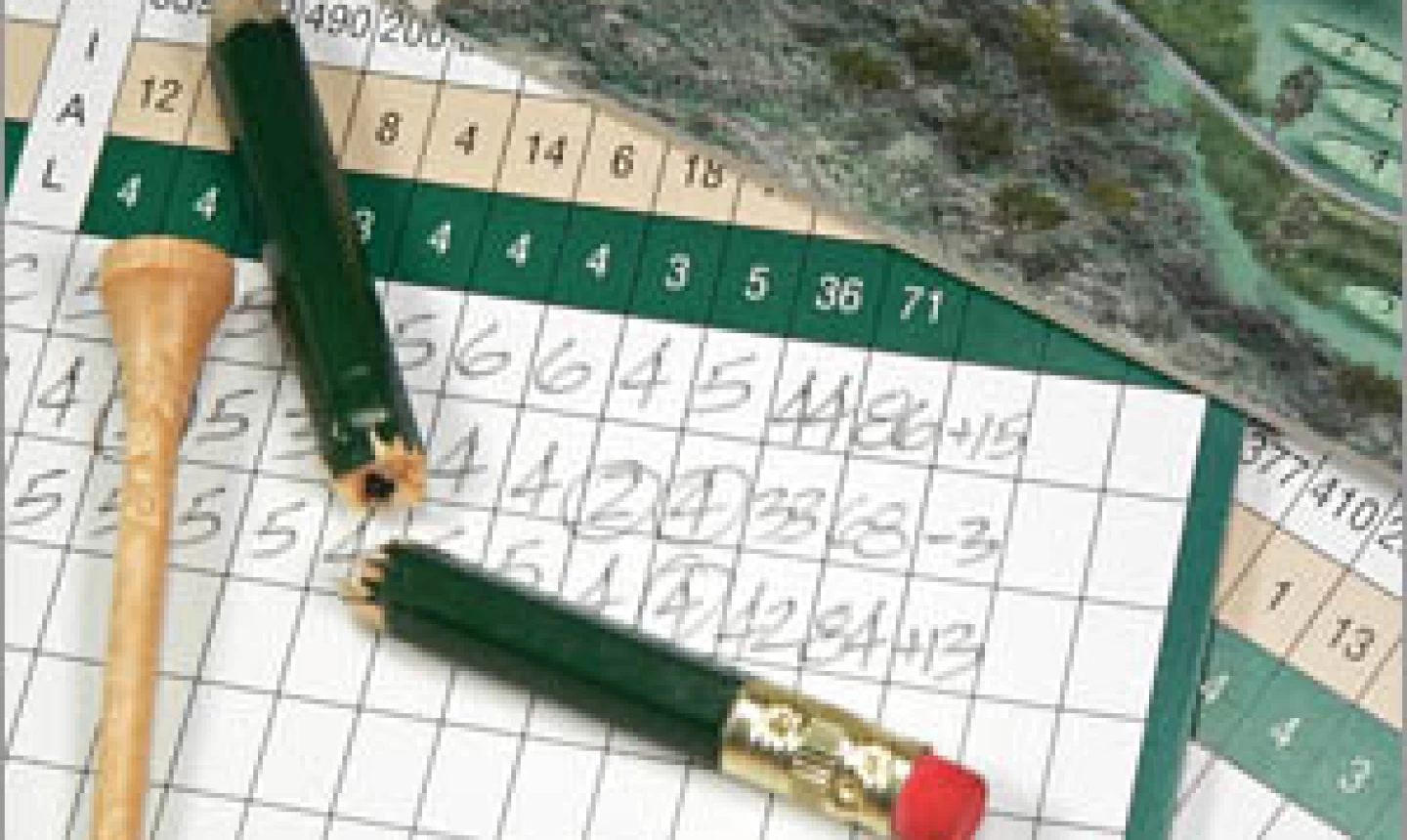
One of the greatest things about golf is that, thanks to the handicap system, players of widely differing skill levels can engage in competitive matches with one another. By allowing less accomplished players to subtract a certain amount of strokes from their score (thus eliminating the better player's advantage) a 26 handicap, for instance, can play against a five-handicap and have an equal chance of winning.
At your home course, it's pretty easy to determine how many strokes you are either giving to, or receiving from, your playing partners if everyone actively tracks their golf handicap. All you need to do is check the golf handicap printouts in the clubhouse or use the standard golf handicap formula (a quick-reference conversion chart usually hanging somewhere in the locker room makes this easier).
Everything changes, however, when you're on a golf vacation, because a person's golf handicap is based on the slope rating, or difficulty, of the course being played. So, more accurately, what's important is everyone's "course handicap," and the opportunity to pick up a stroke here or there isn't lost on anyone, especially during competitive buddy trips. In fact, the haggling over who gets how many strokes becomes a full contact sport that often starts at dinner the night before the group steps onto the opening tee.
To avoid the inevitable and potentially costly debate (both in dollars and in friendships), we have developed a series of tips on how one can use GHIN, the Golf Handicap and Information Network (developed by the USGA) to ensure everyone receives their due. We've also created a handy, downloadable chart you can keep in your golf bag that's easier to use than plugging everything in to the golf handicap formula. So, don't panic, math-o-phobes, we'll explain everything.
To determine everyone's course handicap, you first need to know each player's golf handicap index (obtaining an "official" USGA golf handicap index is a simple but strict process better described at USGA.org).
Of course, one can rely on everyone to "remember" their golf handicap index, but we prefer to use GHIN. At GHIN.com, click on "Handicap Lookup" and you can check the golf handicap index for any registered user as long as you know their state, last name and a partial spelling of their first name. You can even print out the results in case anyone needs a friendly reminder of their golf handicap index.
Now all you need to do is convert the golf handicap indexes into course handicaps for each player. To do that, you'll need the slope rating for each course you plan to play. You can usually find that at each course's website, in GHIN's "Ratings Lookup" area, or at the USGA's "Course Ratings and Slope" database. Remember that slope ratings differ based on the tees you play.
If you are not connected to the internet, the golf handicap formula to determine a course handicap is (Handicap Index × Slope Rating ÷ 113).
Once everyone has a course handicap, the rest is easy. For example, if player A is a 15 and player B is a 12, player A would be allowed to deduct three strokes (one stroke on each of the three hardest holes) to even everything out.
A final note: while the GHIN system is a boon when playing in North America, the golf handicap system described above usually won't help you overseas, as many parts of the world (including the UK and Ireland) use the Standard Scratch Score system. Let the arguments over who gets how many strokes begin!





My US handicap index is 15, and my home course handicap is 17. What handicap do I use when playing in Ireland, where they do not have course ratings?
Question: if I have a GHIN index of 5.5 what is my handicap? Thanks
[...] But with the debut of the new Bahia Golf Course, Punta Mita now has a layout that can hold up to most any player, regardless of their golf handicap. [...]
I don't think the USGA recognizes "couples handicaps," so there is no "official" way of calculating them. Best to find out what equation your course/club is using, then check their math.
I have a handicap of 21 for 9 holes and my husband has a handicap of 16 for 9 holes. How are scores adjusted for couples play? We shot a 49 and ended up with an adjusted score of 44. Is this correct and if so please explain the process. Louise
I can explain it. You either: 1) witnessed one of the greatest miracles in golf, 2)added wrong, or 3) got sandbagged
Recently my friends and I took our annual trip to Orange County National.My question to you is what are the odds that a 22.1 HDCP with a course index of 24/25 would end up shooting 14-15 under par over four rounds? We are at loss on how to explain this. Thanks CS
Playing off the lowest handicap is what most people do. I'm sure there are arguments against it, but it's quick, easy, and fair (again, be sure to convert to 'course handicaps' first). Lots of tournament formats and betting games can be found online (try thegolfexpert.com/golf-on-course-betting.php). In my experience, the best formats with large groups of varying handicaps are ones where everybody's score matters (not just the better players). Keeps everyone involved and part of the fun.
Not really a comment--more of a question.Going to Orange County National in April with 12 friends for our annual "man trip".We usually play off the lowest handicap in the group.Is this fair-any ideas?Maybe some ideas on a tournament format as well. Thanks Adam Fader